Our first Zoom Christmas Party was successfully hosted on 23 December 2021.
Against the outbreak of Omicron variant in Hong Kong, we practised social distancing by celebrating virtually from different locations. Having been used to real-time technology in day-to-day legal services, we further utilized video conferencing to bring valuable memories of festive joy and companionship.
We wish colleagues, clients and members of the legal profession a new year with good health and happiness, and look forward to resuming a physical celebration next year.
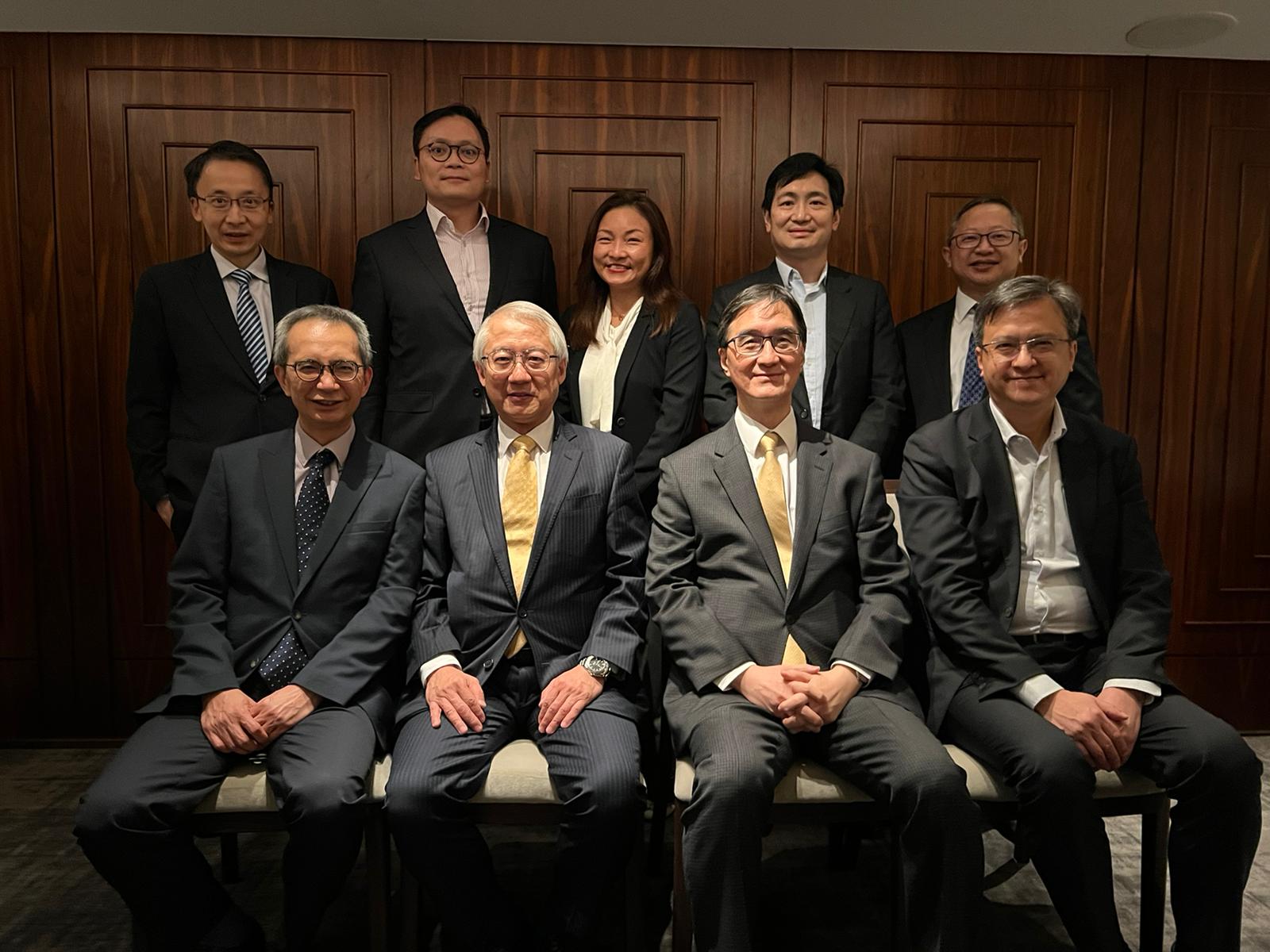
Sunny Chan, Donald Choi, Peter Chan and Albert Wong came to our new office on 16 November 2021. Joseph Wong, Peter Sit and Roy Leung took photos with them in front of the huge cake they brought and at the reception area.
Our firm acted for 803 Funds Limited in its judicial review application against the Secretary for Education for his refusal to disclose “the names of the schools and the teachers involved and the findings and results of investigation in the substantiated cases” of professional misconduct of teachers. This case had attracted much public attention.
The Honourable Chow JA in his Judgment of 28 September 2021 granted permission to our client to make an application for judicial review as our client’s case was reasonably arguable with a realistic prospect of success.
While the Court, after full consideration of the arguments on “Fairness”, “Adverse Impacts” and “Trust and Confidence” and other Grounds, rejected the substantive judicial review application, the Court made no order on legal costs as the application was reasonably arguable.
The case was led by our partners Peter Sit, Alex Chan and assisted by our associate Alan So.
We are pleased to announce that Senior Partner C. K. Kwong was elected as President of the Hong Kong Institute of Arbitrators (HKIArb) on 29th September 2021.
The members of HKIArb comprise of Hong Kong professionals involved in arbitration, mediation and other kinds of dispute resolution (ADR). Hong Kong is designated to serve the role of a regional and international ADR hub. The main objective of HKIArb is to promote arbitration and other methods of ADR. HKIArb is involved in the training of arbitrators and mediators, and setting of appropriate standards of conduct.
Mr. Kwong proposed statutory guidance on arbitrability of intellectual property disputes and is instrumental in the enactment of Hong Kong’s Arbitration (Amendment) Ordinance 2017 (came into force on 1st January 2018) which gave Hong Kong the extra edge to serve as an ADR hub for resolving intellectual property disputes. This legislation has inspired corresponding amendments and intended amendments to the arbitration laws in other jurisdictions. Mr. Kwong is a Chartered Arbitrator of the Chartered Institute of Arbitrators London.
We are pleased to announce that Senior Partner, C. K. Kwong and Partner Roy Leung sat for and passed the first Guangdong, Hong Kong, Macau Greater Bay Area (GBA) Legal Professional Examination which took place on 31st July 2021. This is part of a 3-year pilot programme launched to enable Hong Kong and Macau legal practitioners to obtain Mainland qualifications to practise as lawyers in GBA. Upon being qualified, Hong Kong legal practitioners are allowed to provide Mainland legal services in GBA on specified civil and commercial matters (including contentious and non-contentious matters) to which Mainland laws apply, after passing the qualifying examination and obtaining a practicing certificate.
We are proud of our firm’s partners joining the first batch of the Hong Kong legal professionals who have passed the PRC qualifying examination. Our firm’s ability to provide diversified legal services and safeguard the interests of our clients having a presence or operation in GBA will be further enhanced.
We have recently acted for a Mainland client in an arbitration at the Hong Kong International Arbitration Centre and successfully won an award against various BVI and PRC respondents. The arbitration was to determine a pre-IPO investment dispute involving an investment amount of US$10,000,000. The arbitral tribunal was invited to rule on the broad questions as to whether the redemption right under an investment agreement had been properly exercised and whether the guarantors are liable for the principal debtor’s non-compliance with the redemption request. Parties were engaged in extensive arguments over various technical legal issues including applicability of court pleading rules in arbitration proceedings, estoppel, legal construction on “delivery”, “completion” and “listing”, applicability of the common law principles of reasonable time and nature of guarantee and indemnity obligations. With great pleasure, the arbitral tribunal ruled in favour of our client on liability, and found that the redemption right was exercised properly and in time. The principal debtor shall be responsible for its failure to redeem the subject shares and a guarantor is jointly liable for such default.
The case was handled by our litigation partner Mr. Roy Leung and our litigation associate Mr. Alan So. The arbitration was conducted in Chinese and Putonghua.
We are glad to announce that Dr Michael West has finished his training with us on 27 July this year. In the past few months of his training, Dr Michael West has shown his great ability and been of a great assistance to us. After completion of the training and pending admission as a Solicitor, he will be going to Taiwan to further his studies as well as to take up a teaching position in a university in Taipei. We hereby sincerely wish him a bright and promising future.
Our Consultant Ms. Sylvia Siu JP successfully hosted the Facilitative and Evaluative Mediation for International and PRC Disputes Training Programme, organized by the Hong Kong Institute of Arbitrators.
Our Litigation Associates Mr. Mathew Liu, Mr. Ricky Cheung, Mr. Alan So and our Trainee Solicitor Ms. Koey Wong completed this 4-day training programme, and received valuable guidance from former Judge of the Court of Final Appeal, practitioners and academians from the PRC (especially the Greater Bay Region), Singapore, Australia and Hong Kong.
In parallel with our established litigation practice, we engage in versatile and professional alternative dispute resolutions (ADR) with cross-border exposure. Our dispute resolution team is experienced, energetic and equipped to excel.
Following the signing of the “Record of Meeting on Mutual Recognition of and Assistance to Bankruptcy (Insolvency) Proceedings between the Courts of the Mainland and the Hong Kong Special Administrative Region” on 14 May 2021 (the “Record of Meeting”), the field of mutual recognition of and assistance to insolvency proceedings in Hong Kong and the Mainland has officially reached a new milestone. The Record of Meeting has mainly laid down the following :-
The signing of the Record of Meeting has further confirmed the status of HKSAR as an international legal hub. Under the mechanism laid down by the Record of Meeting, it is the Hong Kong insolvency proceedings and the liquidators appointed in Hong Kong being recognized by the Mainland courts. There is no strict requirement that the company concerned must be a company registered in Hong Kong. This not only accommodates the practical reality that many listed companies in Hong Kong are offshore companies, but also meets the international standard.
Meanwhile, the signing of the Record of Meeting has strengthened the preservation of assets of the debtors and also the protection of creditors’ rights in both HKSAR and the Mainland. The Record of Meeting provides a clearer mechanism to allow the courts of HKSAR and the Mainland to implement orderly and efficient insolvency administration and debt restructuring schemes, which will provide further confidence to the creditors and also investors. In particular, where a Mainland company’s major assets locate in Hong Kong, the Mainland administrators can preserve the company’s assets and proceed with liquidation more effectively through the mechanism under the Record of Meeting. This also reduces the risk of being unable to execute the liquidation of the company in Hong Kong from the perspective of the Mainland creditors.
In fact in early 2020, our firm managed to contribute to some groundbreaking development in assisting the Mainland administrators to seek the Hong Kong court’s recognition of the Mainland insolvency proceedings and assistance. The two landmark cases in this area were both handled by our firm, namely Re CEFC Shanghai International Group Ltd [2020] 1 HKLRD 67 (the “CEFC Shanghai Case”) and Re The Liquidator of Shenzhen Everich Supply Chain Co, Ltd [2020] HKCFI 965, which were the first two precedents in this area of law. The Honourable Mr. Justice Harris reiterated the principles that the Hong Kong Court would consider before granting recognition and assistance to liquidators/administrators appointed in other jurisdictions, and such recognition and assistance were eventually so granted to our clients who were bankruptcy administrators appointed by the Mainland courts.
His Lordship particularly mentioned in the CEFC Shanghai Case that “The extent to which greater assistance should be provided to Mainland [insolvencies] in the future will have to be decided on a case by case basis and the development of recognition is likely to be influenced by the extent to which the [Hong Kong] court is satisfied that the Mainland, like Hong Kong, promotes a unitary approach to transnational insolvencies.” As the pioneer in this area, our firm believes that following the signing of the Record of Meeting and the implementation of the details, the work to assist the Mainland administrators to seek recognition of and assistance to insolvency proceedings from Hong Kong court in the future can be carried out more effectively and expeditiously.
The aforesaid cases are all handled by our partner Mr. Roy Leung with the assistance of our litigation associates. Our firm is experienced in handling a wide variety of insolvency matters, and will offer assistance to other stakeholders to insolvency proceedings under the framework of the Record of Meeting in the future.
The written decisions of the aforesaid cases can be found at the following websites :-
Re CEFC Shanghai International Group Ltd [2020] 1 HKLRD 676
Re The Liquidator of Shenzhen Everich Supply Chain Co, Ltd [2020] HKCFI 965
We act for 803 Funds Limited in an application for judicial review against the Secretary for Education (the “Secretary”) challenging his decision in refusing to disclose to our client the names of teachers and schools, the findings and results of the investigation in substantiated misconduct cases (the “Withheld Information”). Our client submitted to the Court that the Secretary’s decision should be quashed based on the following reasons:
This case is led by our Litigation Partner, Mr. Alex Chan, and assisted by our Associate, Mr. Alan So.
This case has been reported extensively by the media after the court hearing on 20 May 2021. Below is a link to a media report published by Speakout Hong Kong: https://www.speakout.hk/港人點播/71637/-
We act for 803 Funds Limited in an application for leave for judicial review to challenge the decision of the Education Bureau refusing to disclose the names of the schools and teachers involved and the findings and results of the investigations in certain substantiated professional misconduct cases. On 20 April 2021, we attended a hearing at the High Court to oppose an application taken out by Hong Kong Professional Teachers' Union (the “HKPTU”) for leave to join in the legal proceeding as a party. Upon considering the evidence submitted by the HKPTU and also the submissions of the respective parties, the court agreed with our client’s opposition and rejected the HKPTU’s application on the ground that it will not be able to provide additional, material assistance on the law, fact or the consequences of the judgment and awarded costs in our client’s favour. This case is led by our Litigation Partner, Mr. Alex Chan, and assisted by our Associate, Mr. Alan So.