Background
The signing of the Arrangement on Mutual Service of Judicial Documents in Civil and Commercial Proceedings between the Mainland and the Hong Kong Special Administrative Region on 20 April 2026 marks a transformative milestone in the judicial history of cross-border disputes (“New Arrangement”).
The New Arrangement addresses the limitations in the previous 1999 regime by introducing multimodal service options, including electronic service, and by streamlining court-to-court entrustment through digitalization to accommodate the surge in cross-border cases, thereby aligning judicial mechanisms with the digital realities of modern commerce, and enhancing litigation efficiency.
Historical Foundation: The Old Arrangement in 1999 and the Need for Reform
The origins of mutual service between Hong Kong and the Mainland are rooted in Article 95 of the Basic Law, which empowers the Hong Kong to maintain judicial relations with the legal departments of other parts of the country. Shortly after the handover, the Arrangement for Mutual Service of Judicial Documents in Civil and Commercial Proceedings between the Mainland and Hong Kong Courts was established in 1999 to provide a formal channel for cooperation with court-to-court entrustment as the service channel (“Old Arrangement”).
Under the Old Arrangement, service was conducted through a centralized, high-level administrative process. Requests were channeled through the High Court of Hong Kong and the various Higher People’s Courts in the Mainland. While this provided a stable and fixed legal basis, it somehow lacked flexibility in the rapid expansion of cross-border commerce. Practitioners often experienced delays in attempting service, leading to additional costs and procedural uncertainty.
The limitations of the Old Arrangement became even more pronounced during the COVID-19 pandemic, which highlighted the gradual obsolescence of a system that solely depended on physical transmission and personal delivery. After 27 years of implementation, the Old Arrangement deserves a full review and upgrade. The New Arrangement enhances the service process through retaining the core entrustment mechanism and adding diverse means to ensure timely and effective service.
The New Arrangement: Scope and Multimodal Framework
The New Arrangement applies to judicial documents in civil and commercial proceedings where service must be effected across the border. Article 2 defines “civil and commercial proceedings” broadly, encompassing matters that are civil or commercial in nature under the laws of either jurisdiction (with only a few exclusions). The types of litigation-related documents covered are exhaustive, ensuring that practitioners can utilize the Arrangement at every stage of legal proceedings, from the originating process to the enforcement of judgments.
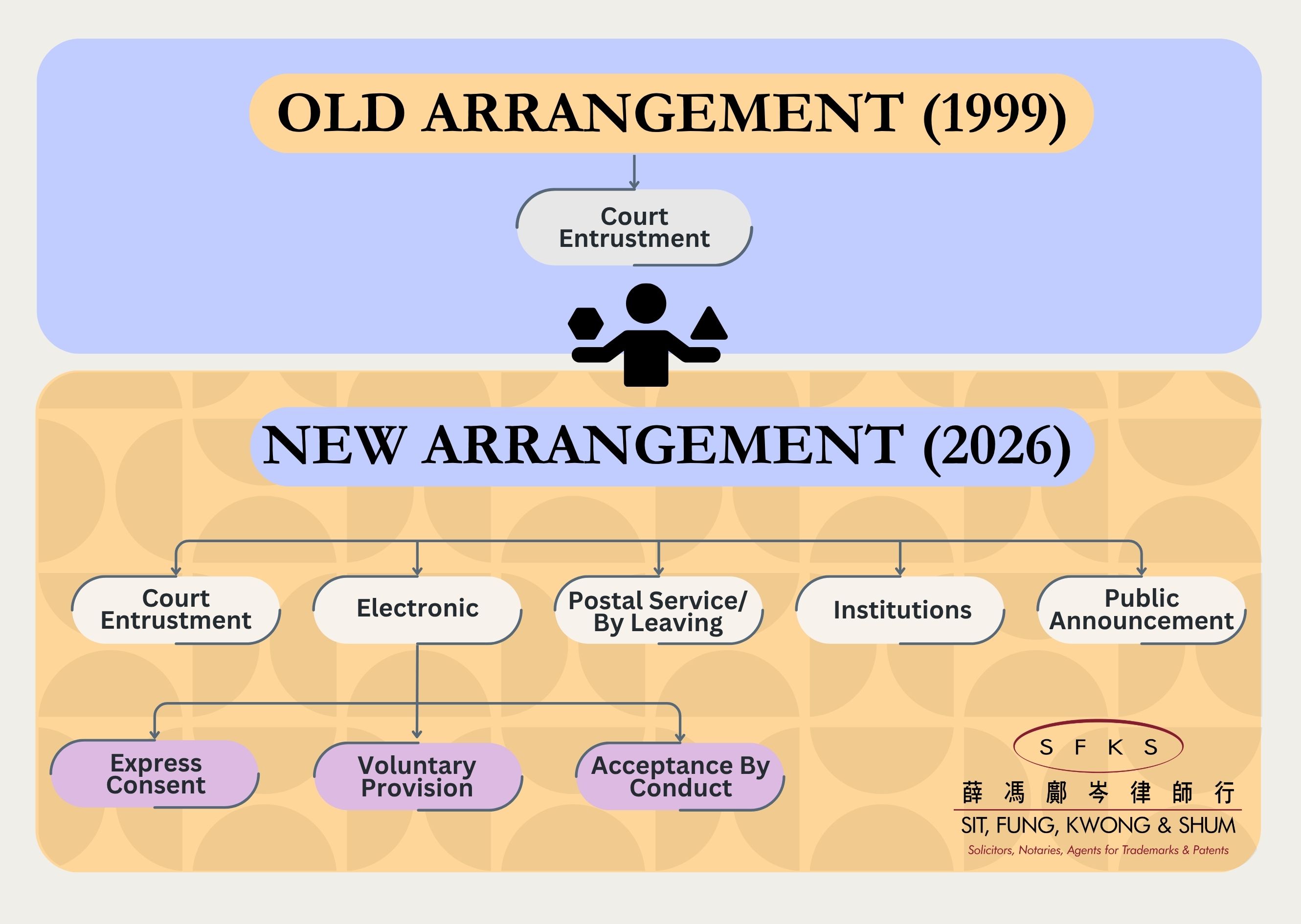
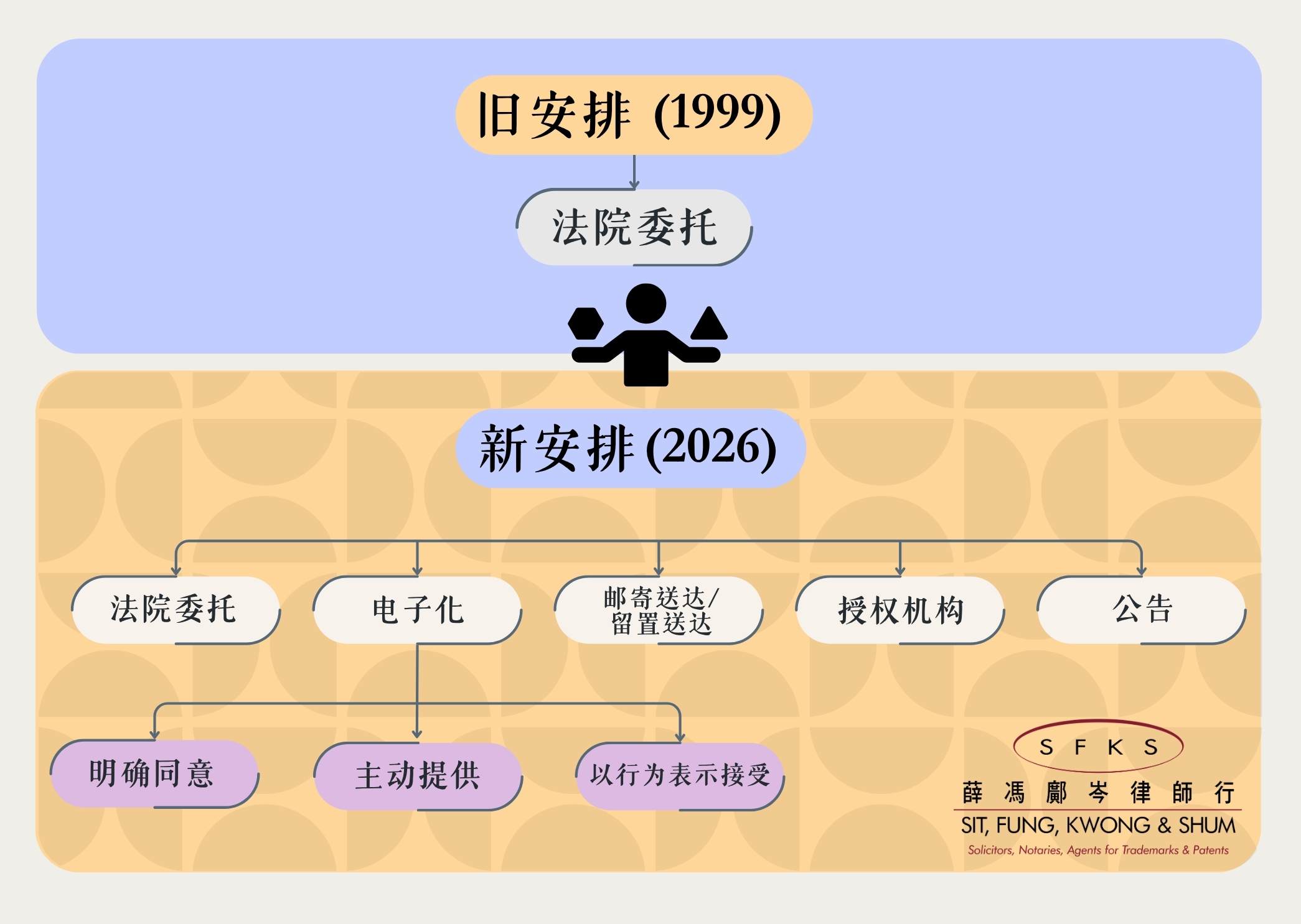
Article 3 introduces the revolutionary principle of multi-modal service, allowing for court-to-court entrustment, electronic service, postal service, service by authorized persons, and public announcement. The advantages of a multi-modal service regime are two-fold.
First, there was only one option under the Old Arrangement i.e. through the courts, yet there are various options for means of service under the New Arrangement.
Second, these modes can be used in parallel. If a plaintiff attempts service via multiple channels, the date of service is determined by whichever mode first achieves successful delivery. This eliminates the previous “wait-and-fail” cycle, allowing parties to pursue the most efficient path to commencing their action.
Option 1: Electronic-supported Court-to-court Entrustment
While the New Arrangement expands service options, court-to-court entrustment remains a vital pillar of mutual assistance. Article 4 decentralizes this process, allowing the Supreme People’s Court to authorize certain intermediate people’s courts and primary people’s courts to entrust service directly to the High Court of Hong Kong, following consultation with the Hong Kong Judiciary.
Articles 5 and 6 lay out the standards for electronic transmission and language. Judicial documents transmitted electronically between courts are now granted the same legal effect as physical originals. To prevent procedural errors, the entrusting court shall produce a letter of entrustment in Chinese when requesting for service of judicial documents. If the underlying judicial documents are in English or another language, they must be accompanied by a Chinese translation. Furthermore, when serving a Hong Kong registered company, the letter of entrustment must include a printed copy of the company’s latest registered address from the Hong Kong Companies Registry, ensuring that documents reach the correct legal entity.
Option 2: The Digital Leap – Electronic Service
The gist of the New Arrangement is the inclusion of electronic service. Article 14 permits service via facsimile, electronic mail, mobile communications, and other instant-receipt systems, provided that receipt by the intended party can be ascertained. This provision effectively brings electronic means into the formal legal framework of cross-border litigation, provided one of the specific conditions of (i) express consent, (ii) voluntary provision or (iii) acceptance by conduct are met. Please refer to the table of descriptions of each specific condition for electronic service.
Electronic service may be helpful as personal service via the Mainland courts under the Old Arrangement may sometimes be unsuccessful. Besides, electronic service would cater the modern reality that parties travel across the whole country and no longer base in a particular city or fix oneself to a particular address.
Options 3-5: Other Means of Service
Postal Service and By Leaving
Beyond digital channels, the New Arrangement formalizes postal service and service by authorized persons, providing a robust set of alternatives to court bailiffs. Under Article 8, the courts in Hong Kong and Mainland may effect service of judicial documents by direct service, postal service, electronic service, service by leaving at the addressee’s place and service by public announcement provided in Article 17 of the New Arrangement.
Law Firms or Notarization Institutions
Article 15 also introduces service by third party authorized institution. Mainland courts may authorize service in Hong Kong by Hong Kong law firms or registered foreign law firms. Conversely, Hong Kong parties may effect service in the Mainland through Mainland law firms or notarization institutions. Instead of waiting for court-to-court entrustment, parties can use a designated professional to attempt service directly, which can facilitate the legal proceedings and reduce delay in service.
Public Announcement
When all direct attempts to serve on the recipient fail, Article 17 provides for service by public announcement. Service by public announcement is deemed effective 60 days after the date of publication. This 60-day period is a standardized timeframe that provides legal certainty for the court to move forward with the proceedings, even if party remains absent. From our firm’s experience, service of documents under the Old Arrangement may take more than 60 days.
Transitioning the Legal Framework: From Old to New Arrangement
The New Arrangement is a treaty-like agreement that requires implementation through domestic law. In Hong Kong, it requires amendments to rule 5A of Order 11 in Rules of the High Court which currently prescribes the rigid court-to-court process for serving writs in the Mainland.
The New Arrangement would only take effect once the legislative procedures are completed and the Supreme People’s Court has issued its corresponding judicial interpretation. During the transitional period, the Old Arrangement remains in force.
Insights
Legal practitioners, corporate groups and cross-border business entities are advised to stay close with the development and implementation of the New Arrangement. Meanwhile, the following matters would deserve deeper consideration.
First, regarding the specific conditions for electronic service, voluntary provision by the defendant and acceptance by conduct of the defendant might be rare. Therefore, it is imperative that the plaintiff will have the defendant’s prior express consent. Practically speaking, contracting parties who anticipate the potential need of enforcing the contract (and their legal representatives) may consider the incorporation of relevant clauses in advance to record the parties’ express consents for electronic service of legal documents arising from contractual disputes.
Second, as much as the benefits lie on the plaintiffs (or the parties enforcing a contract), the New Arrangement may be less welcomed by defendants as it shorten the time between the plaintiff’s originating documents and the time of actual or deemed service). Defendants on receipt of originating documents, even by electronic service, should seek Hong Kong legal advice as soon as practicable.
Third, there has been legislative discussions on whether, or to what extent, the application and requirements of electronic services of local HK-to-HK service procedures are tallied or synchronized with cross-border service procedures under the New Arrangement. The underlying spirit is that local HK-to-HK service procedures should be no less practicable and effective than cross-border service procedures.
In any event, the ability to efficiently serve judicial documents across the border is essential for managing the complex disputes that inevitably arise in international trade and finance. By aligning the legal mechanisms of the two jurisdictions, the New Arrangement reduces the uncertainty and hurdles in procedures, making Hong Kong an even more attractive seat for arbitration and litigation.
This article is co-authored by our Partner Mathew Liu and our Trainee Solicitor Jaimie Ho.
Disclaimer :
This material is provided for general information only. It does not constitute legal or other professional advice nor constitute any lawyer-client relationship between Sit, Fung, Kwong & Shum and any user or browser. No liabilities are assumed arising from any reliance on the information in this material.
Sit, Fung, Kwong & Shum is a Hong Kong law firm and does not practice or provide legal advice on the laws of other jurisdictions. References to the laws and practice of any other jurisdictions in this material are provided for general reference and comparative purposes only, and do not constitute any advice, opinion or representation on the law or practice in those jurisdictions.