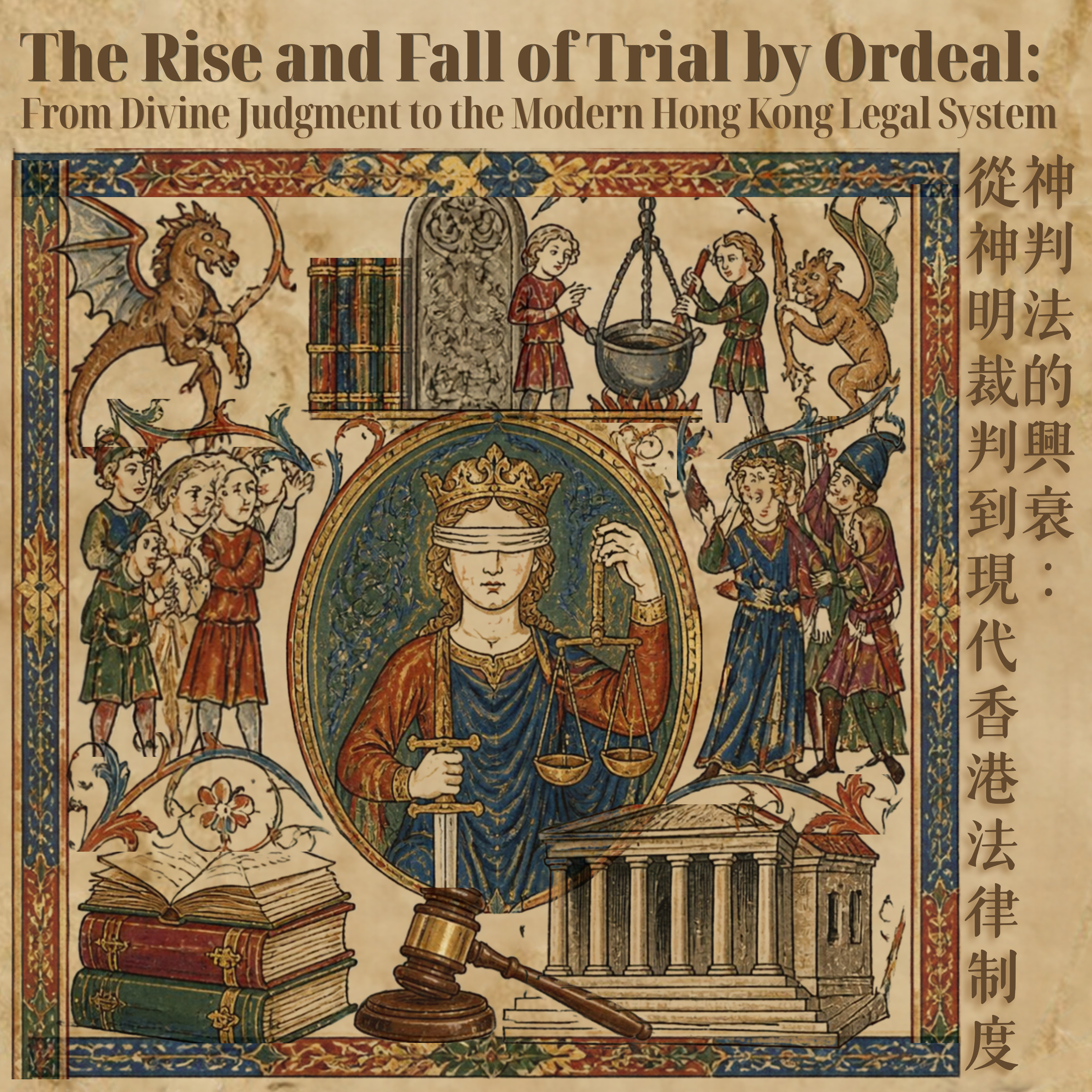
A. Introduction: Germanic Origins, Purpose, and Impact
For modern legal practitioners in Hong Kong, the notion of resolving a dispute by exposing an accused person to red-hot iron or freezing water appears not merely archaic but antithetical to justice. Hong Kong’s legal system rests on principles of procedural fairness: Defendants are informed of the case against them, are given the opportunity to respond, are entitled to legal representation, and may challenge the evidence presented by the prosecution. Yet, for several centuries, this very practice, known as trial by ordeal, formed a central part of the early English legal system, the tradition from which Hong Kong's own common law framework ultimately derives. To understand the roots of our own common law inheritance, it is worth examining why a system once placed its faith in fire and water rather than in witnesses and juries.
Trial by ordeal did not originate with the English courts. The ordeal was fundamentally an appeal to supernatural intervention. The earliest form mentioned in the written records before 800 AD is the ordeal of the hot water cauldron, vividly described in Gregory of Tours’ De gloria martyrum. The academic consensus strongly suggests a Frankish origin, as the ordeal appears in the Salic Law (i.e. the Frankish civil law code compiled in around 500 AD by Clovis) but is absent from the law codes of other Germanic peoples such as the Burgundians, Alamanni, Bavarians, and Saxons. The Carolingian legislation furthered and enforced the ordeal: in 809 AD, Charlemagne ordered that “let all believe in the ordeal without any doubting.”
The purpose of the ordeal was profound. In an era without professional police forces, forensic science, or even a developed law of evidence, the ordeal served as a final arbiter for cases that could not be resolved by other means. The ordeal was “a device for dealing with situations in which certain knowledge was impossible but uncertainty was intolerable.” Within the English legal system, ordeal involved an appeal to God to assist in the detection of perjury and required priestly participation to mediate the necessary rapport with the deity. It was not a marginal curiosity but, for a time, a primary method of proof for serious accusations, particularly those involving hidden crimes, sexual misconduct or lack of certain proof such as witnesses or written evidence. The eventual abandonment of this practice in the 13th century would set the English common law on a path that, centuries later, would be carried to Hong Kong – a path that leads directly to the jury system, the burden of proof, and the rules of evidence that define our courts today.
B. How Ordeal Was Conducted: Fire and Water
The conduct of trial by ordeal – whether by cold water or by hot iron – was a highly ritualized and public event, subject to specific ecclesiastical and royal regulations.
The ordeal was never a spontaneous act. A man accused of a crime would, after a solemn three-day fast, pick up a hot iron, walk three paces, and put the iron down. His hand would be bandaged and sealed, then, after three days, inspected. If it was “clean” – that is, healing without suppuration or discoloration – he was innocent or vindicated; if the wound was unclean, he was guilty. The same principle applied to the ordeal of boiling water, where the accused had to pluck an object from a bubbling cauldron.
The cold water ordeal operated on an inverted logic. The accused would be bound and lowered into a pond. If the body sank, the water was deemed to have "received" it with God's blessing, and the accused was quickly retrieved. If the body floated, the water was said to have rejected the accused, and this was taken as proof of guilt.
Both forms of ordeal shared two important features. They were unilateral, usually undertaken by only one party in the case, and they required that the natural elements behave in an unusual way: hot iron or water not burning the innocent, cold water not allowing the guilty to sink. In this respect, they differed fundamentally from trial by battle, the other major form of divine proof.
The ordeal’s heyday lasted four centuries from 800 AD to 1200 AD. It was employed only when other ways of discovering the truth were not available – it was a last resort, not a first report. The ordeal existed in a judicial framework that recognized many other forms of proof, such as swearing an oath, compurgation, examination of written evidence or witnesses, or some form of inquest. In England, in fact, resolution of civil cases by the ordeals of fire and water was always rare; for example, property disputes were resolved by the duel more often than by hot iron or cold water.
C. Comparison: Ordeal vs. Trial by Battle
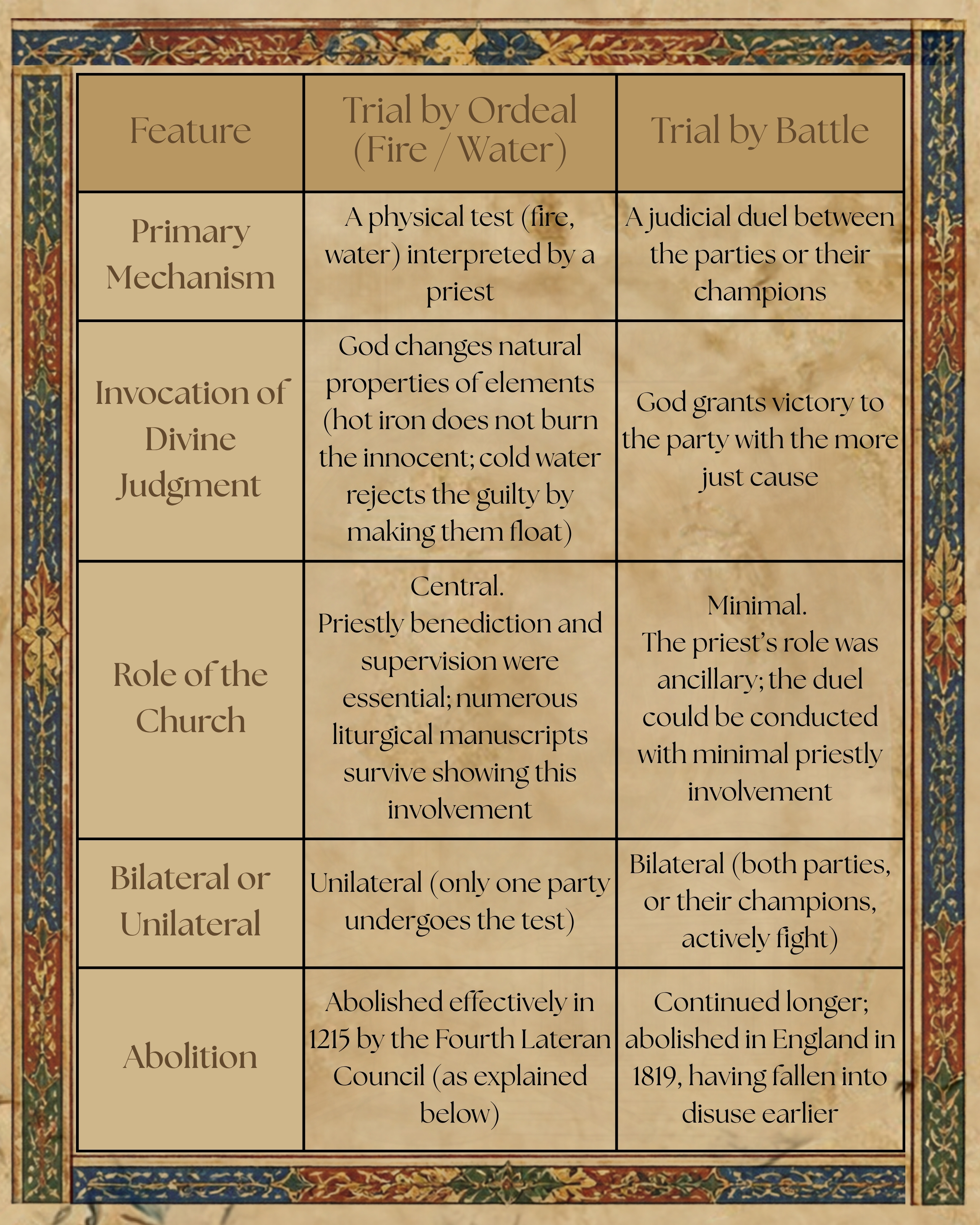
A reader of English legal history will also encounter trial by battle, another form of primitive proof. While both the ordeal and trial by battle belong to the category of “judgments of God,” they differ fundamentally in their mechanism and social logic. The following comparison can be drawn :-
Trial by Ordeal (Fire / Water)
Primary Mechanism: A physical test (fire, water) interpreted by a priest
Invocation of Divine Judgment: God changes natural properties of elements (hot iron does not burn the innocent; cold water rejects the guilty by making them float)
Role of the Church: Central. Priestly benediction and supervision were essential; numerous liturgical manuscripts survive showing this involvement
Bilateral or Unilateral: Unilateral (only one party undergoes the test)
Abolition: Abolished effectively in 1215 by the Fourth Lateran Council (as explained below)
Trial by Battle
Primary Mechanism: A judicial duel between the parties or their champions
Invocation of Divine Judgment: God grants victory to the party with the more just cause
Role of the Church: Minimal. The priest’s role was ancillary; the duel could be conducted with minimal priestly involvement
Bilateral or Unilateral: Bilateral (both parties, or their champions, actively fight)
Abolition: Continued longer; abolished in England in 1819, having fallen into disuse earlier
D. The End of the Ordeal: The Lateran Decree of 1215 and “Tempting God”
The dramatic abandonment of trial by ordeal in England and across the Western Christendom can be traced to a single canonical decree issued by the Fourth Lateran Council in 1215. Convened by Pope Innocent III, this ecumenical council expressly forbade clergy from participating in trials by ordeal, a prohibition that proved fatal to the practice. The papal decision was not a belated recognition of a long process of decline; on the contrary, the ordeal remained in active use throughout much of Europe at the time, especially in view of the fact that the right to hold ordeals was a form of property appurtenant to a church, producing revenue from fines, confiscations, and fees paid to the priests. Rather, the council's decree represented a deliberate policy choice, rooted in the ideological conviction that the ordeal was an illicit "tempting of God": an impious attempt to force divine intervention through a human ritual. The theological reasoning was that the ordeal constituted “tempting God”: human reason should be used to its utmost, and miracles are not guaranteed. A miracle is a free act of God; there is no regularly ordained procedure to procure it. If the ordeal were regarded as a miracle, it was a very improper one, since it involved a ritual that demanded a miraculous effect every time to be judicially useful. To be useful, the ordeal had to work every time, but this guaranteed result was precisely what made it an impious testing of God.
The intellectual attack on the ordeal had deeper roots. 9th century criticism by figures such as Agobard of Lyon argued that the ordeal was “an invention of men”, a proof that God never ordered, and that it was superfluous given that God had ordained judges and magistrates to decide cases by witnesses or oaths. Hincmar of Reims raised the discordance between hot and cold water ordeals. Most significantly, Pope Stephen V’s letter Consuluisti provided the first explicit papal condemnation: “the holy canons do not consider that a confession should be forced from anyone by the examination of hot iron or hot water … what is not sanctioned by the teaching of the holy fathers is a superstitious invention.”
The Lateran decree of 1215 proved decisive and removed the essential liturgical and supervisory role that the Church had long played in the ordeal, rendering the practice legally and theologically untenable. In England, the abolition of trial by ordeal was recognized in royal ordinances of 1219.
E. Replacement: The Rise of the Jury and the Use of Torture
With the ordeal rendered inoperable, the English legal system was forced to innovate. The primary replacement was the gradual expansion of the trial jury. Juries of presentment already existed in 12th century England, but their task was to indict felons, not to decide guilt or innocence. Over the course of the early 13th century, they developed into trial juries. The path of inclination for the English was to extend jury procedure to fill the enormous gap left by the abolition of ordeals.
A striking parallel could be drawn between ordeal and jury. The inscrutability of the jury’s verdict was reminiscent of ordeal procedure. As J. Jouon de Longrais puts it, “their verdict is accepted without discussion and formalistically. It has all the archaic firmness of the old proofs. It acts on the material question, the matters of fact, like a kind of ordeal. One cannot ask its reasons, still less begin it over again.” The jury bound the judges just as the ordeal had bound them. It is this inscrutable and binding quality that makes sense of the claim that “the jury was first seen as a new ordeal.”
However, the procedure that really blossomed in the 13th century, filling the role earlier played by the ordeal, was judicial torture. As the 13th century progressed, judicial torture was employed increasingly frequently, at first against suspected criminals in Italian cities, later by the Inquisition and by royal judges in France. This new solution differed from the old one in several ways. It was designed to extract a confession rather than swiftly reveal guilt or innocence. It made no appeal to God and did not depend on priestly involvement. It was heavily biased against the accused, since his only recourse was to endure torture, which could often be repeated. Torture, a judicial procedure in human hands, was more unrelenting than the judgment of God. Like the ordeal, torture was a last resort, used for “invisible” crimes of belief such as heresy and witchcraft, where full and acceptable proof was lacking but some presumption against the accused existed.
As judicial torture was distinctively rejected in the common law, the jury system thrived to profound long-term consequences for the common law tradition that Hong Kong inherits today.
F. Conclusion
The medieval trial by ordeal – born from Frankish custom, ritualized by the Church, and abandoned for tempting God – is not merely a curious footnote. Its abolition created a legal vacuum that gave rise to the jury, shifted the burden of proof, and reinforced the demand for rational, human-administered justice. These developments travelled with the common law and eventually taking root in Hong Kong, where they remain embedded in our legal system today.
To understand the ordeal is to understand the deep historical reasons why our courts look to evidence, not to miracles; to juries, not to priests; and to reason, not to fire or water. The modern court does not await a miracle; it examines evidence. It does not test God; it tests the credibility of witnesses. It does not bind wounds; it binds parties to the evidence.
G. Source and Further Reading
The factual content of this article is drawn from and summarizes the following two books :-
- Bartlett, Robert. Trial by Fire and Water: The Medieval Judicial Ordeal. Oxford: Clarendon Press, 1986.
- Baker, John. An Introduction to English Legal History. London: Butterworths, 1971.
These books provided the historical foundation for the discussion of the origins, conduct, abolition, and aftermath of trial by ordeal, as well as its place within the broader evolution of the medieval legal system. Readers seeking a more detailed examination of the medieval judicial ordeal or the development of early legal procedure are encouraged to consult the original works.
Disclaimer: This material is provided for general information only. It does not constitute legal or other professional advice nor constitute any lawyer-client relationship between Sit, Fung, Kwong & Shum and any user or browser. No liabilities are assumed arising from any reliance of information in this material.